A diagnostic (or beauty quiz, skin test, personalized check-up, whatever you call it) turns an anonymous visitor into an identified contact with a full profile: skin type, concerns, habits, life context. But that data only generates revenue if you actually use it. The post-diagnostic flow is the email sequence triggered automatically in Klaviyo when someone completes the diagnostic: it's the step that converts the first-party data you collected into revenue.
Most people who complete an online diagnostic don't buy right away. Yet they've expressed a specific need, handed over their contact details and received a personalized recommendation. The post-diagnostic email sequence exists to recover those deferred sales, and the brands that work on it seriously turn it into one of their most profitable sequences.
For this article, we completed the diagnostics and quizzes of 4 brands (Typology, Respire, DIJO, Byoma) and analyzed every email received over the following days: subject lines, timing, formats, mechanics. Part one: what shows up across all of them, and how to build your own segmentation and personalization logic in Klaviyo. Part two: the detailed breakdown, brand by brand.
1.The post-diagnostic flow, the step that turns data into revenue
A visitor who finishes a diagnostic is in a rare state: they've just spent 2 to 3 minutes describing their need, they've received a recommendation they perceive as personalized, and they've handed over their email to get it. It's the most qualified contact in your database.
Three windows then open up:
All 4 brands we analyzed structure their sequence along these lines.
2.What every brand does: the shared structure
Before getting into each example, here are the 6 constants we observed across the 4 sequences. It's the foundation to build yours on.
Comparative overview
| Brand | Emails | Cadence | Dominant angle | Incentive |
|---|---|---|---|---|
| Typology | 4 | D0, D+1, D+4, D+5 | Result + reassurance | None |
| Respire | 4 | D0, D+1, D+2, D+3 | Science and experts | -10% unique code, in the PS |
| DIJO | 3 | D0, D+2, D+3 | Urgency and gift | Free product, deadline |
| Byoma | 3 | D0, D+1, D+3 | Product conversion | -15% everywhere |
Constant 1: 3 to 4 emails across 3 to 5 days, at a fixed time
That's the norm we observed. The flows are triggered in Klaviyo (or equivalent) on diagnostic completion and each email goes out at the same time as the previous one. No endless sequence: the post-diagnostic window of interest closes within a week.
Constant 2: the D0 email has one job
Deliver the result, one single CTA to the results page, no hard selling (Byoma excepted). The first email is the most opened of the whole sequence: it establishes the value of the diagnostic, it doesn't give it away cheap.
Constant 3: the results page is the hub of the whole sequence
The “see my results again” or “my routine” CTA comes back in every email, at every brand. Each person has a unique link to their results page, and everything converges on it.
Constant 4: personalization happens at three levels
Constant 5: the plain-text “human” email
2 of the 4 brands slip a plain-text email, with no design, signed by a real person with a photo, into their otherwise designed sequence: a scientific-committee expert at Respire, the founders at DIJO. In both cases it carries a benefit framed as a personal favor. This break in format is probably the single easiest idea to replicate in this whole analysis.
Constant 6: the incentive is a positioning choice, not a reflex
Four strategies observed: no discount at all (Typology), a discreet discount in the PS framed as a favor (Respire), a free product with a deadline (DIJO), a discount everywhere (Byoma). The right question isn't “what discount should we offer” but “does my positioning support a discount at all”.
3.How to segment: by profile or by concern
The first structural decision in your flow depends on how your diagnostic is built.
Case 1: your diagnostic produces predefined profiles
Some diagnostics sort every person into a closed typology. That's what Typology does: at the end of the diagnostic you're “PE(-)”, “PS(+)”… a skin typology code from a finite set of profiles. The whole email sequence is then built around that profile: it shows up in subject lines, the customer reviews on display come from people with the same profile, the recommended routine matches the profile.
It's the simplest segmentation to run: one profile = one flow variant.
Case 2: your diagnostic doesn't categorize people
Plenty of diagnostics don't produce a closed typology: they cross-reference answers (concerns, context, habits) to generate a recommendation. In that case, segment by concern or by journey, meaning by the main reason that brought the person to the diagnostic in the first place.
A concrete example of that architecture, for a skin diagnostic that collects around fifteen possible concerns:
| Flow | Diagnostic concerns, grouped |
|---|---|
| Blemishes flow | Acne · Blackheads · Excess sebum · Residual marks and scarring |
| Anti-aging flow | Lines and wrinkles · Sagging · Loss of firmness · Pigmentation spots |
| Sensitivity flow | Redness · Tightness · Reactivity · Severe dryness |
| Radiance and hydration flow | Dull complexion · Dehydration · Uneven texture · Tired-looking skin |
The principle: rather than creating one flow per concern (unmanageable at 15 concerns), you group the ones that share a mindset and a message. Someone worried about wrinkles and someone worried about sagging don't need exactly the same products, but they share the same expectations (proven efficacy, visible results, prevention): same anti-aging flow, with the content personalized inside it via the profile properties.
Segment by existing customer or not, first
Even before concern, segmenting by existing customer versus prospect is near-universal among mature brands. A customer who takes the diagnostic doesn't need to be sold on the brand: their flow is there to deepen the relationship, recommend routine add-ons, or win back a lukewarm customer. A prospect, on the other hand, has to be reassured about the brand before they can be converted.
4.How to personalize your Klaviyo flows with the diagnostic's properties
When the diagnostic is submitted, all the data collected flows automatically into your email tool (Klaviyo in most cases) as profile properties:
If someone retakes the diagnostic, every property is replaced with the new values: the profile always stays current.
These properties do two distinct things, and the two often get confused:
| Use | What it does | Example |
|---|---|---|
| Segment | Decides which flow (or which branch) the person enters | “Acne” profiles go into the Blemishes flow |
| Personalize | Adapts the content inside a single email | A text block that changes depending on skin type |
Segmentation decides the flow. The properties then personalize the content inside the emails:
In other words: even if your diagnostic doesn't sort people into profiles the way Typology does, you get the same level of personalization by segmenting on concern and then injecting the properties (skin type, habits, external factors) into the email content.
5.Detailed example: Typology, the Personalized Result flow
4 emails over 5 days, sent at a fixed time. No discount anywhere in the sequence.
| Day | Subject line | Role |
|---|---|---|
| D0 | Your prescription is ready | Deliver the result |
| D+1 | Typology PE(-): What they think of our products | Segmented social proof |
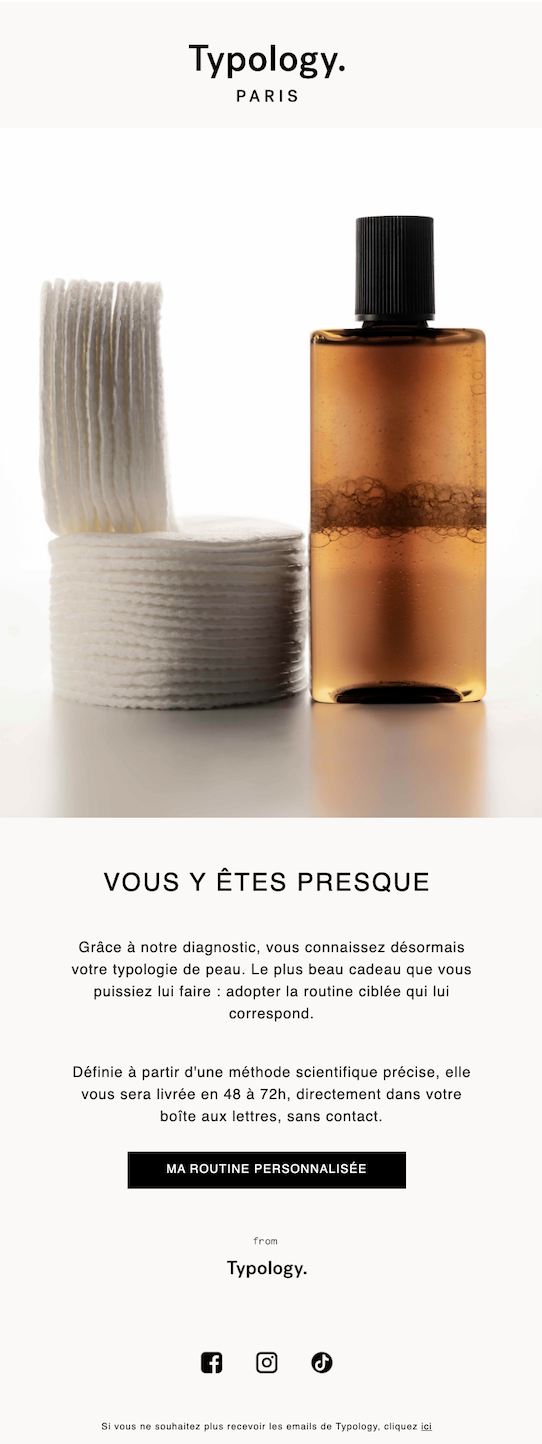
| D+4 | Typology PE(-): the hard part is behind you | Clear the last piece of friction |
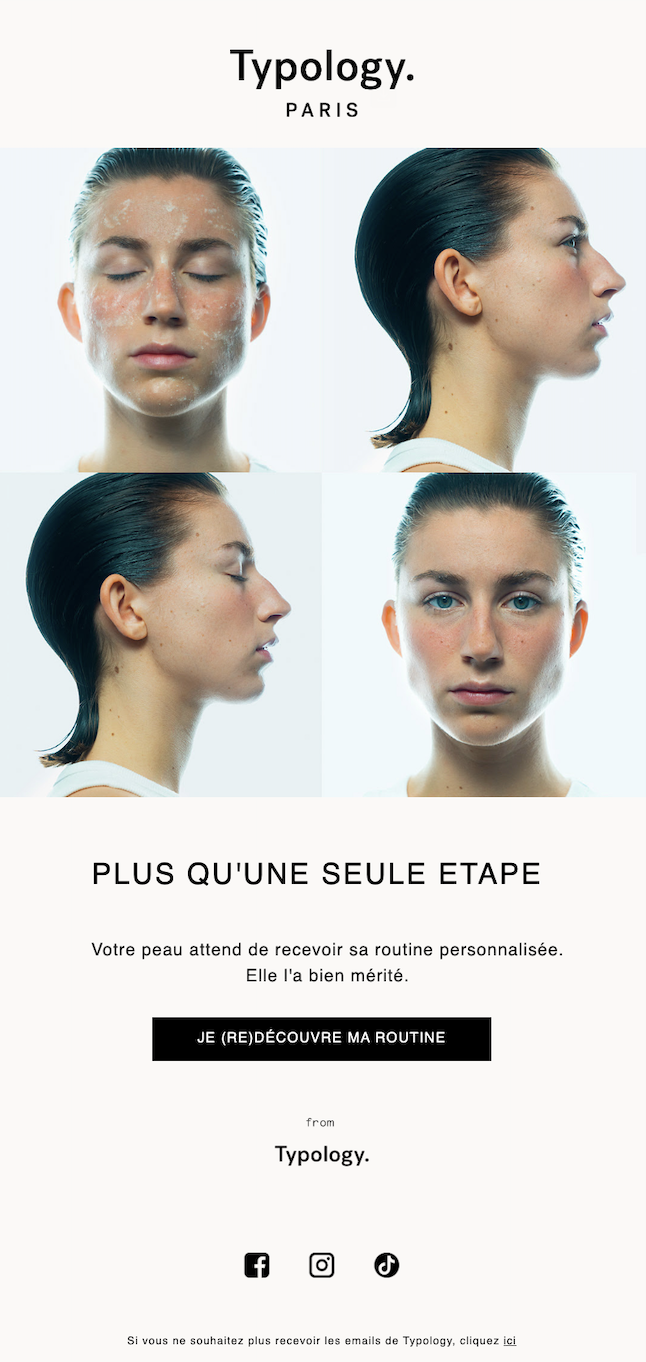
| D+5 | Typology PE(-): Just one step left | Final emotional reminder |
The diagnostic result is in the subject line. “PE(-)” is that person's typology code. Double effect: personalization visible right in the inbox, and a permanent reminder that the brand knows your skin. Directly replicable if your diagnostic passes a skin type or a main concern through as a property.
The vocabulary is clinical and unapologetic: “prescription”, “typology”, “Congratulations”. The diagnostic is treated as an expert act, not a marketing quiz. The D0 email is minimal: no product, no price, a single CTA, “MY PRESCRIPTION”, pointing to the results page.
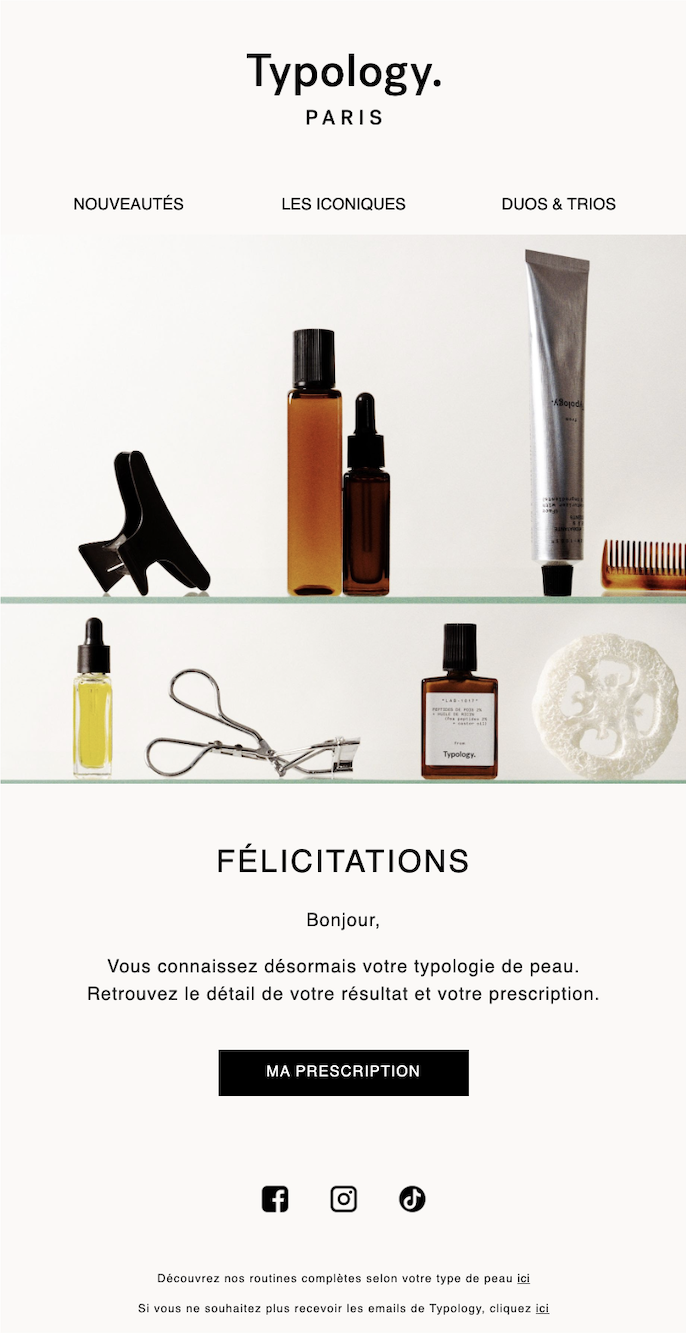
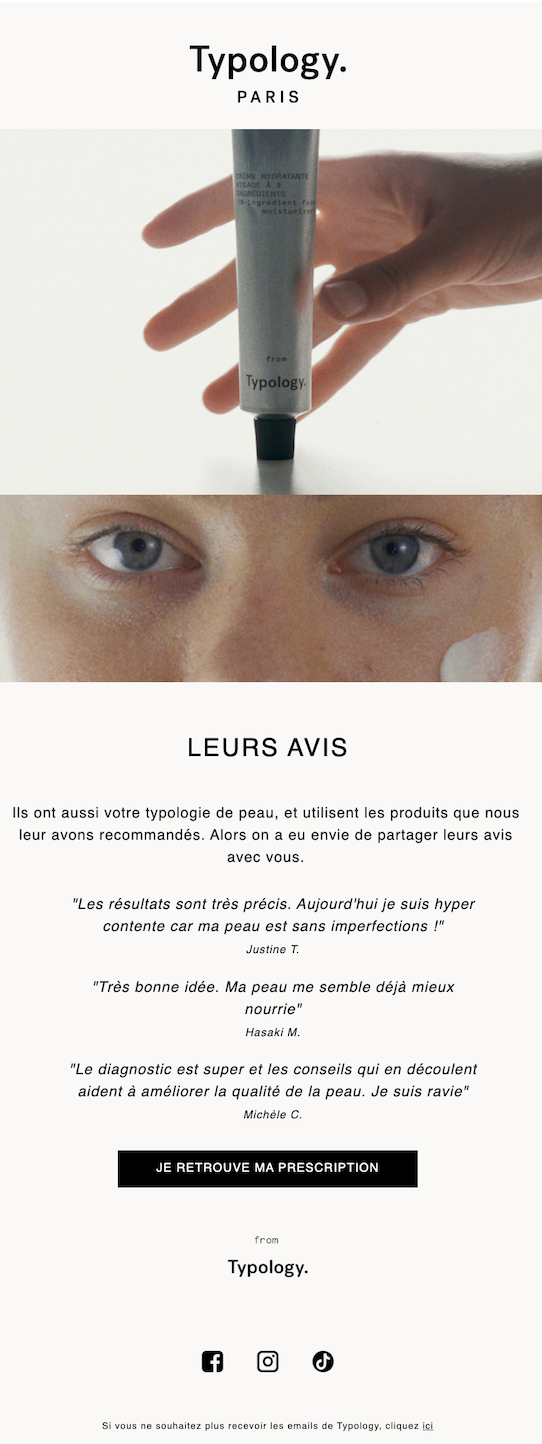
The social proof is itself personalized. The D+1 email shows customer reviews introduced with “They have your skin typology too, and they use the products we recommended to them”. The testimonials aren't generic: they come from people with the same profile. It's the finest level of personalization we saw across the 4 brands.
The end of the sequence plays on emotion, not on a discount. D+4 reassures (“the hard part is behind you”, 48-72h contactless delivery), D+5 personifies the skin: “Your skin is waiting for its personalized routine. It has earned it.” CTA: “(RE)DISCOVER MY ROUTINE”.
Format: clean product images, plenty of white space, a single CTA per email, no distractions.
6.Detailed example: Respire, the Science and objections flow
4 emails over 4 days, sent at a fixed time. One single discount, discreet, framed as a favor.
| Day | Subject line | Role |
|---|---|---|
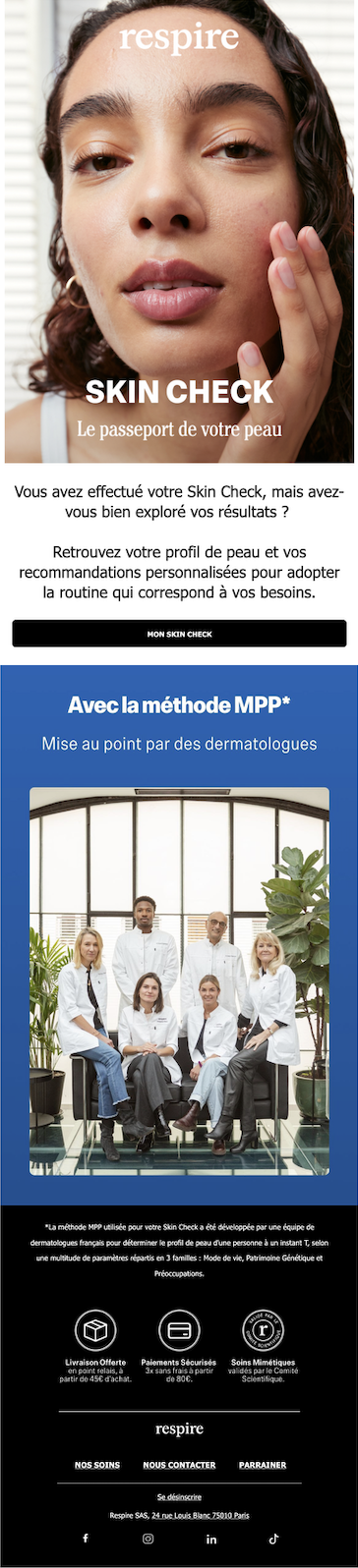
| D0 | Your Skin Check results | Deliver the result + establish the method |
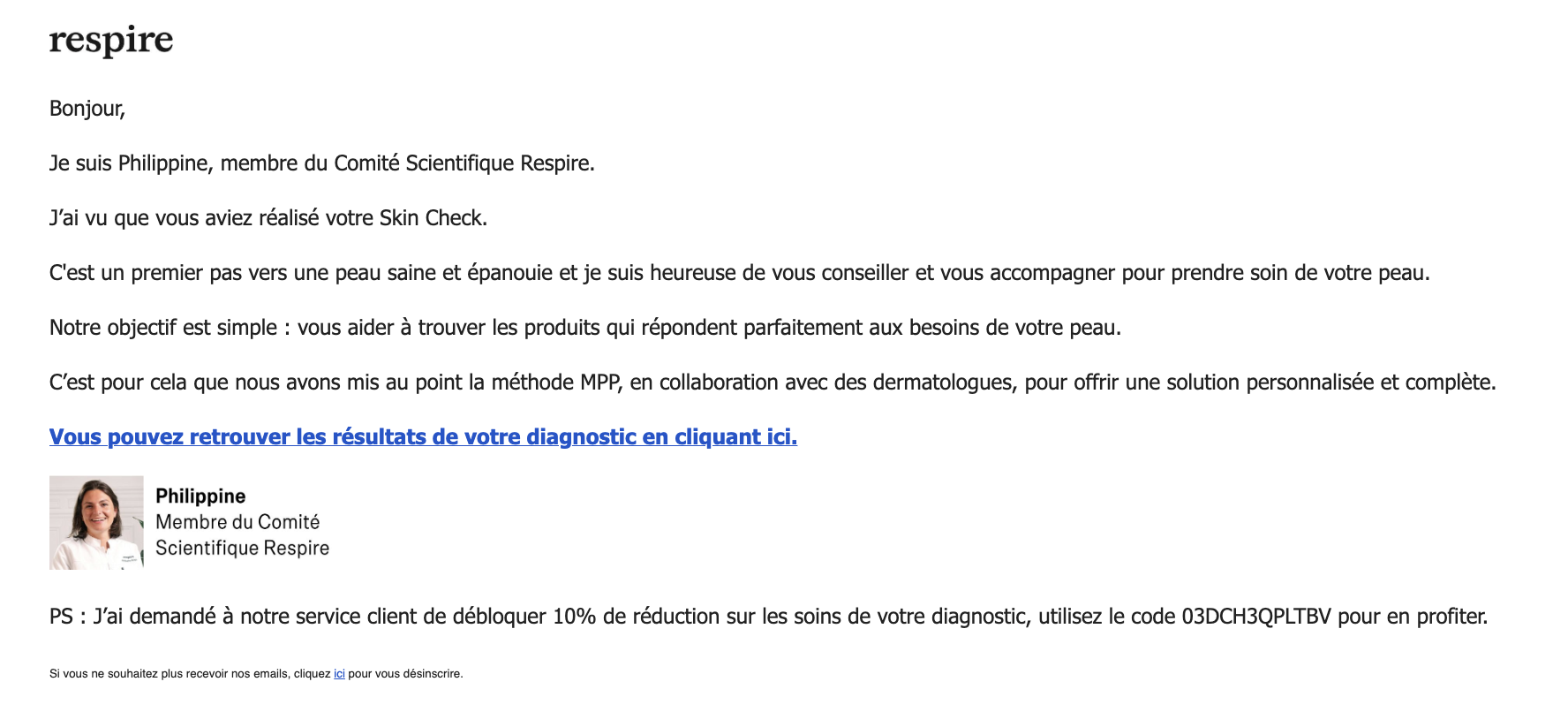
| D+1 | Toward healthy, thriving skin | A human email signed by an expert + a -10% code |
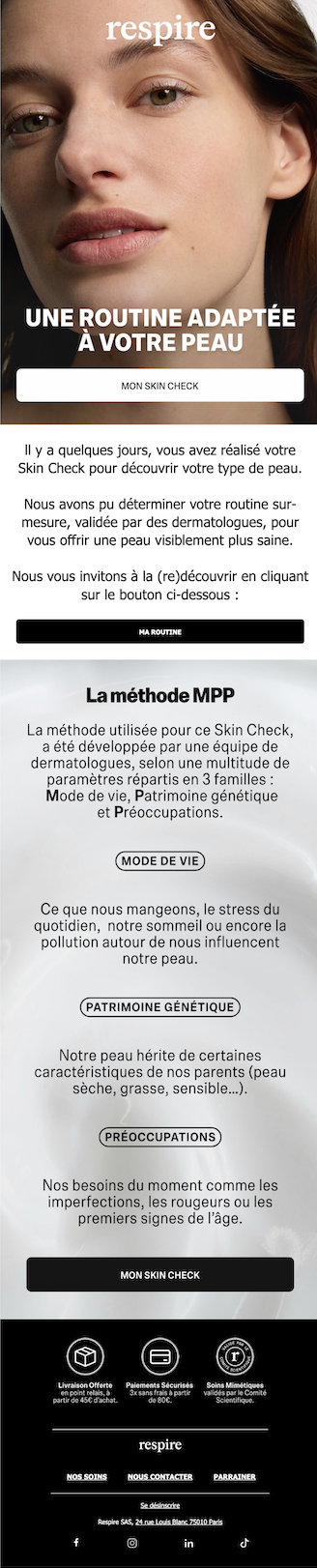
| D+2 | Your skin is unique | Teaching the method |
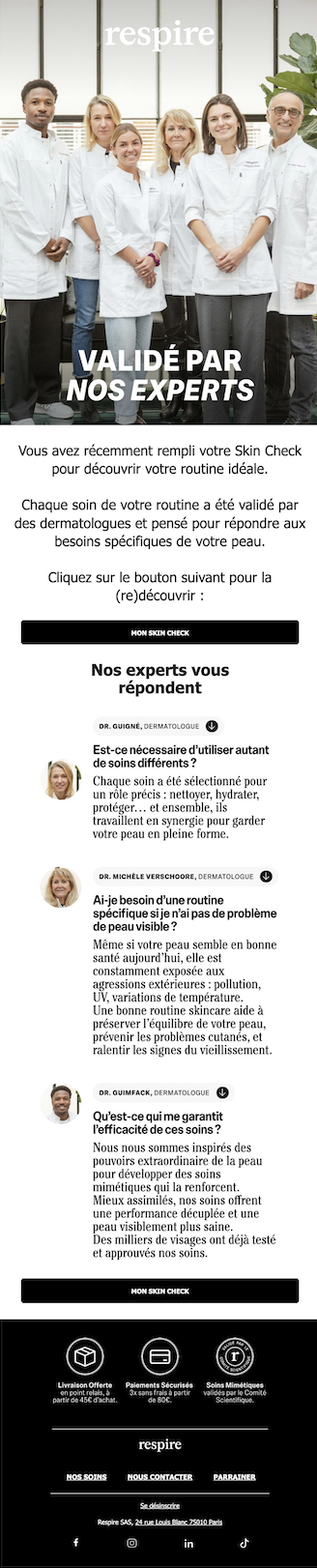
| D+3 | Science in the service of your skin | An objections FAQ answered by dermatologists |
It's the most tightly argued of the four sequences: each email clears a different objection.
D0, the result and the credibility. The diagnostic is presented as “your skin's passport”, and the very first email carries a photo of the dermatologist team and a mention of the MPP method. Scientific legitimacy is established immediately.
D+1, the human email. A plain-text email, with no design at all, signed “Philippine, member of the Respire Scientific Committee”, with her photo and job title in the signature. The PS carries a unique -10% code, framed as a personal favor: “I asked our customer service team to unlock 10% off the products from your diagnostic.” The format deliberately breaks with the designed emails: it reads like a one-to-one message.
D+2, the teaching. An email laying out the MPP method across 3 families (lifestyle, genetics, concerns). The goal: legitimize how reliable the result is before pushing for the purchase.
D+3, the objections FAQ. “Our experts answer you”: three dermatologists, photo and name attached, each answer a genuine purchase objection: “Do I really need to use this many different products?”, “Do I need a specific routine if I have no visible skin problem?”, “What guarantees me these products work?”. It's a closing email dressed up as editorial content.
7.Detailed example: DIJO, the Urgency and gift flow
3 emails over 3 days, sent at a fixed time. A gift as the through-line, with mounting time pressure.
| Day | Subject line | Role |
|---|---|---|
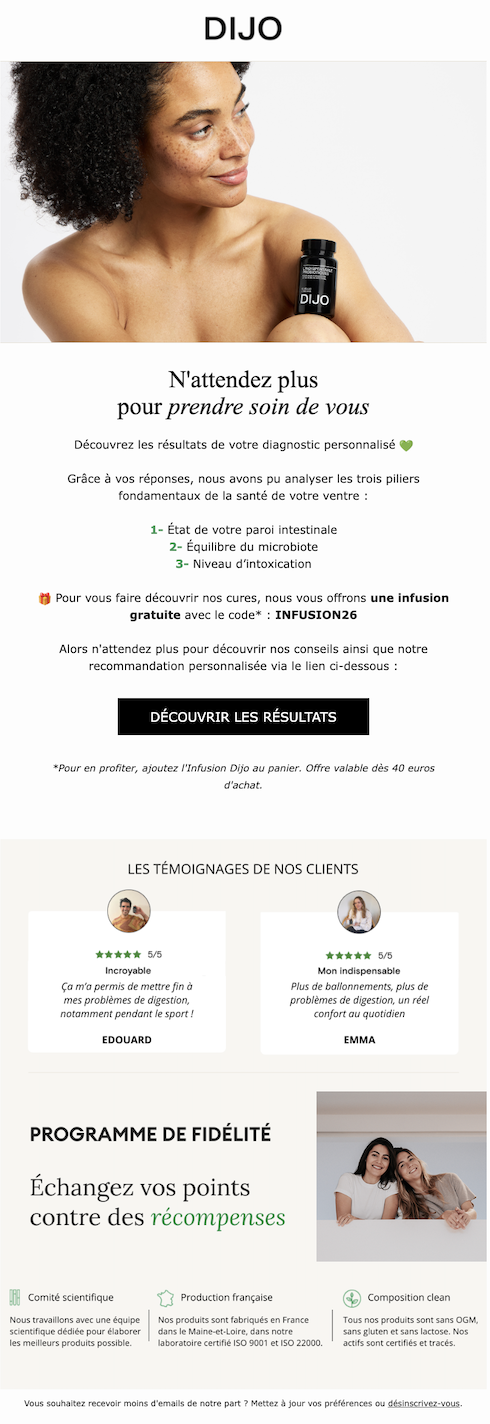
| D0 | A surprise inside your diagnostic 💚 | Deliver the result + announce the gift |
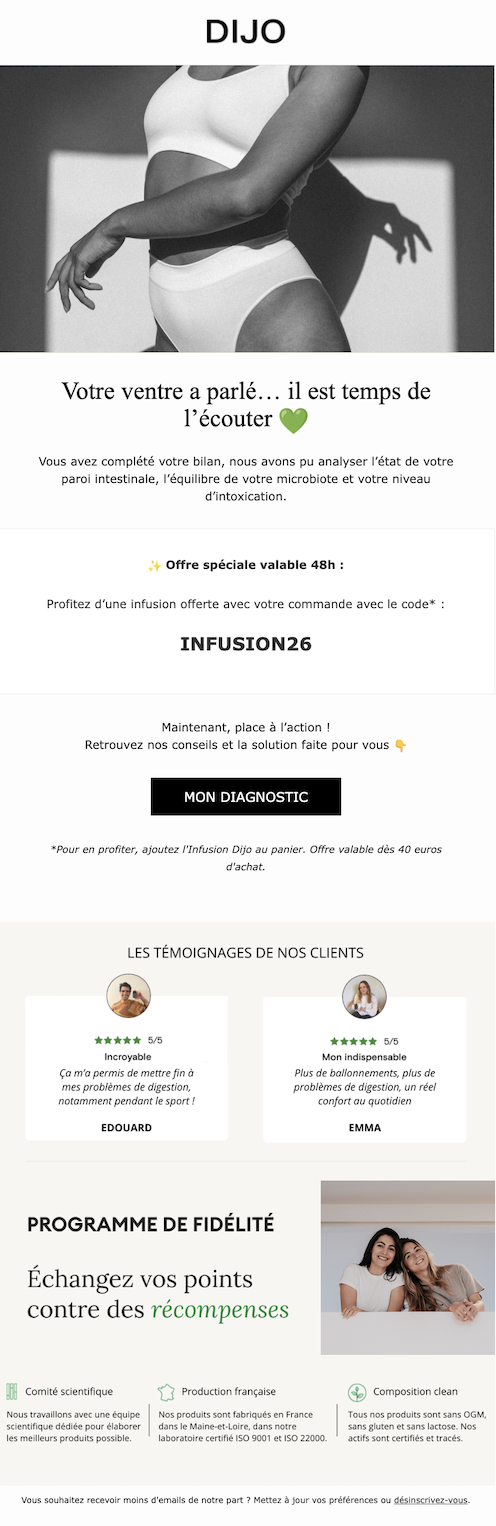
| D+2 | Your gut needs this ✨ | Re-establish the result + a 48h offer |
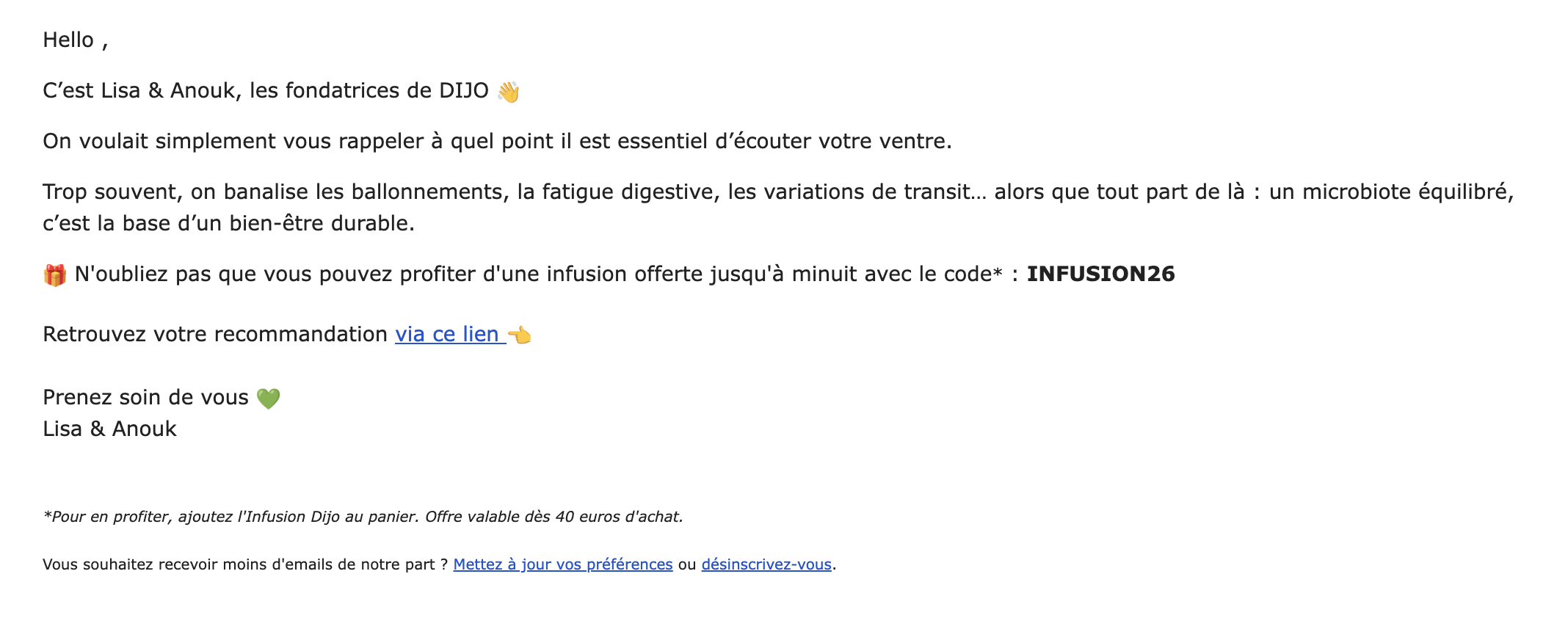
| D+3 | RE: your gift is waiting 💚 | Founders' email + midnight deadline |
The D0 subject line doesn't say “your results” but “a surprise”. The gift (a free herbal tea with the code INFUSION26) is used as an open lever first, then as a reason to complete the order. The diagnostic and the incentive are tied together from the very first contact.
The result is re-established before anything is sold. The D+2 email recaps what the diagnostic analyzed: “the 3 fundamental pillars of your gut health: the state of your intestinal wall, the balance of your microbiome, your level of intoxication”. The person is reminded of the value of what they received before being exposed to the offer.
The time pressure mounts: “special offer valid for 48h” at D+2, then “until midnight” at D+3.
The last email simulates a conversation. D+3 is a plain-text email signed by both founders (“It's Lisa & Anouk, the founders of DIJO”), with an “RE:” prefix in the subject to look like a reply in an existing thread and lift the open rate. Same “human email” mechanic as Respire, but embodied by the founders rather than an expert.
The tone is warm: emojis in all 3 subject lines. The designed emails carry recurring blocks: 5/5 testimonials, the loyalty program, reassurance (scientific committee, French production, clean formulation).
8.Detailed example: Byoma, the Product conversion flow
3 emails over 4 days. A discount everywhere (-15%, code WELCOME15), with the diagnostic built in as a buying aid.
| Day | Subject line | Role |
|---|---|---|
| D0 | Hi Alice, Welcome to BYOMA 🧡 | Welcome + discount + bestsellers |
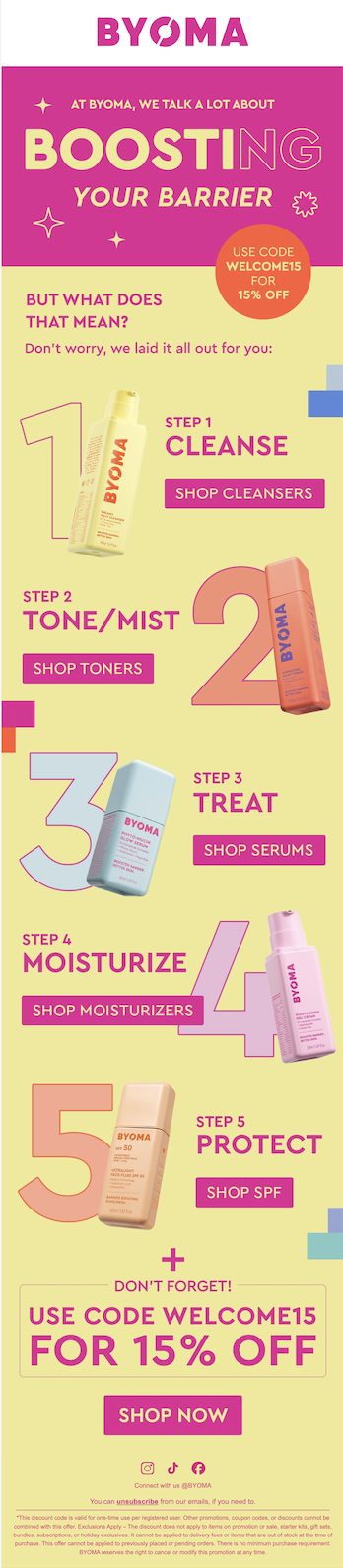
| D+1 | 15% OFF Barrier Boosting Skincare | Teaching the 5-step routine |
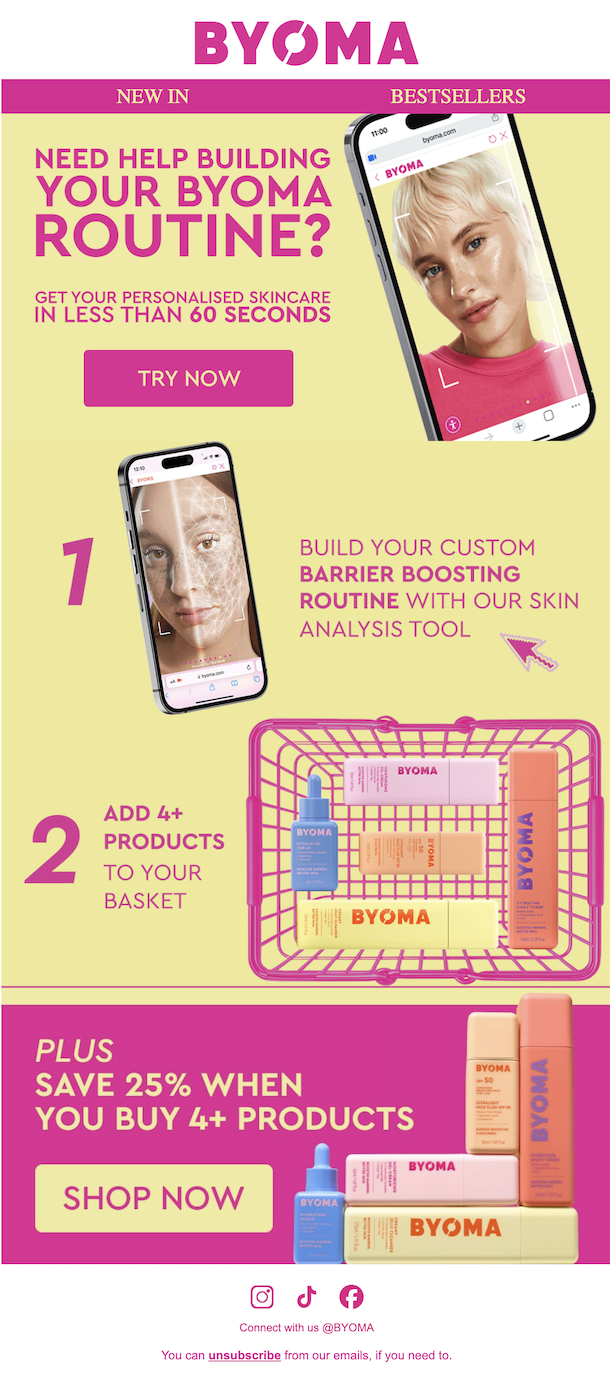
| D+3 | Not sure what to get? BYOMA can help! | Re-promoting the diagnostic |
Byoma flips the logic of the three previous brands: the sequence is above all a promotional welcome flow, and the diagnostic is re-promoted inside the emails as a buying aid: “Get your personalised skincare in less than 60 seconds”, “Build your custom routine with our skin analysis tool”. The first name is in the subject line from D0.
The D+1 email is educational in structure (the 5 steps of a routine: Cleanse, Tone, Treat, Moisturize, Protect) but each step has its own shop CTA. The D+3 email explicitly targets indecision (“Not sure what to get?”) and re-offers the diagnostic as the answer, with a two-step mechanic: take the diagnostic, then add 4 or more products to the cart.

9.Mistakes to avoid
Also worth reading: How do you feature your diagnostic on your beauty e-commerce site?: the 7 placements for maximizing the number of diagnostics started.
Next article: how to configure these flows technically in Klaviyo (lists, properties, triggers, exit conditions and dynamic blocks), step by step.